

The Ugly American
Meet the new boss, just like the old boss

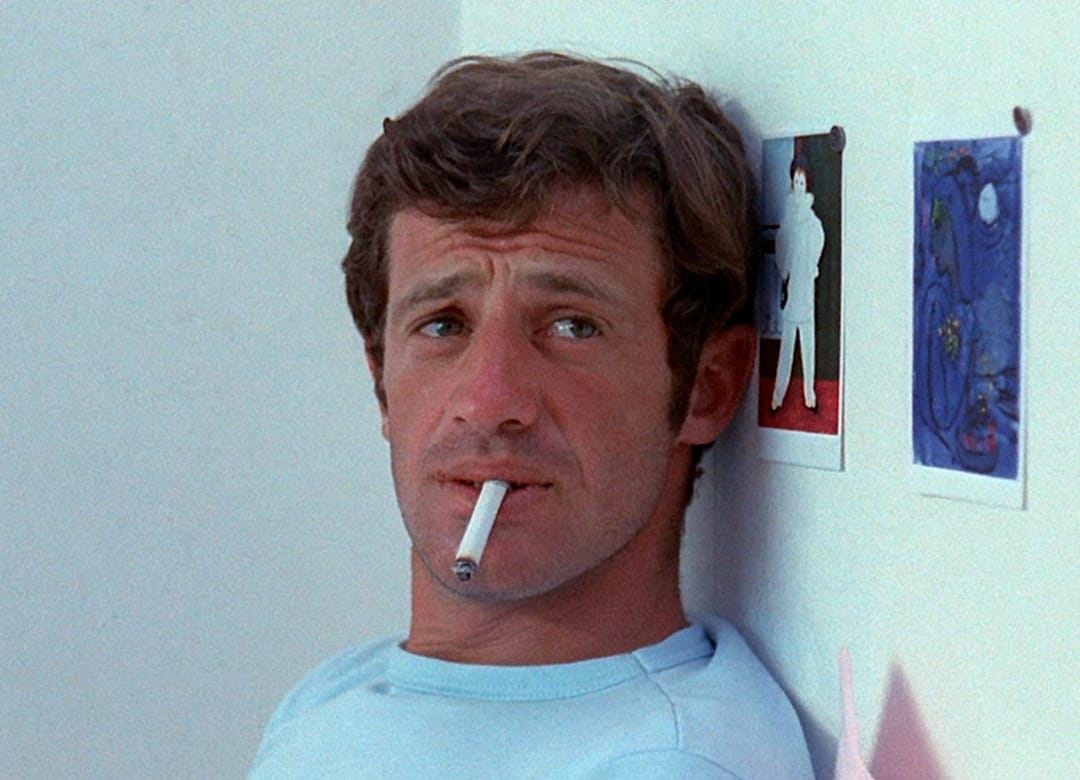
The French guy smoked. Well, of course.
“Vietnam,” he said, with that accent. “Vietnam.”
We were at a bar in Antananarivo, the capital of Madagascar and this French guy - he had a mustache, I remember - was telling me that America was a country of fools and bullies. This was in 2001, more than a quarter century after the Vietnam war ended.
I may not have known enough then to remind him that the French hadn’t done any better, or perhaps I was simply blindsided by his vehemence.
“I was 12 years old,” I managed to choke out.
I remembered tales of anti-American demonstrations in Europe during that war, but this man’s intrusion of ancient enmities felt discordant. Madagascar was gentle and peaceful, or it seemed that way to an outsider. I knew that the Malagasy people harbored well-deserved seething resentments after 30 years of rule by a corrupt president-for-life. The poverty was heartbreaking. But for folks in the capital, there always seemed to be workarounds.
In retrospect, in that summer of 2001 the world held itself in equipoise. Clasped by stillness, violence was something that happened in other places.
The Trump casino is open for business
About the only good thing you can say about Donald Trump is that most people in other countries don’t hate us anymore. They commiserate with us, and, in a sense, they are one with us. Trump is now the human equivalent of the Covid-19 pandemic, a plague afflicting the entire world, except maybe Spain, whose prime minister just told him to fuck off.
To be clear, I make no claim to knowing how the U.S. attack on Iran will end. I don’t believe anyone knows. I do know that the odds of a popular revolt that will install a pro-democracy government are not good. A handover of religious dictatorship to military dictatorship with a vastly reduced arsenal and a deal on oil with Trump Inc. is emerging as the best-case scenario.
Will that constitute a victory or even an improvement? Perhaps for Israel. The Trump crime family will profit, as it does, irrespective of the death toll, which nobody named Trump cares about.
Not so much for the Iranian people, I suspect.
The worst case scenario is not Iraq but what has happened in Libya. After the U.S. helped rid the country of its longtime dictator, an aggressively interventionist policy pushed by then-Secretary of State Hillary Clinton, Libya became a failed state whose people are fleeing in whatever way they can, some dying in small boats as they struggle to cross the Mediterranean.
In the meantime, the U.S. economy looks to be on track to fulfill the promise that our six-time bankrupt president runs true to form. Trump’s toxic combination of poor judgment, impulsiveness, and ignorance are threatening to send the economy straight to hell. Now Trump’s actions are spreading instability throughout the Gulf region and threatening to do the same throughout the globe, as European nations are forced to defend their interests.
It’s the midterms, stupid
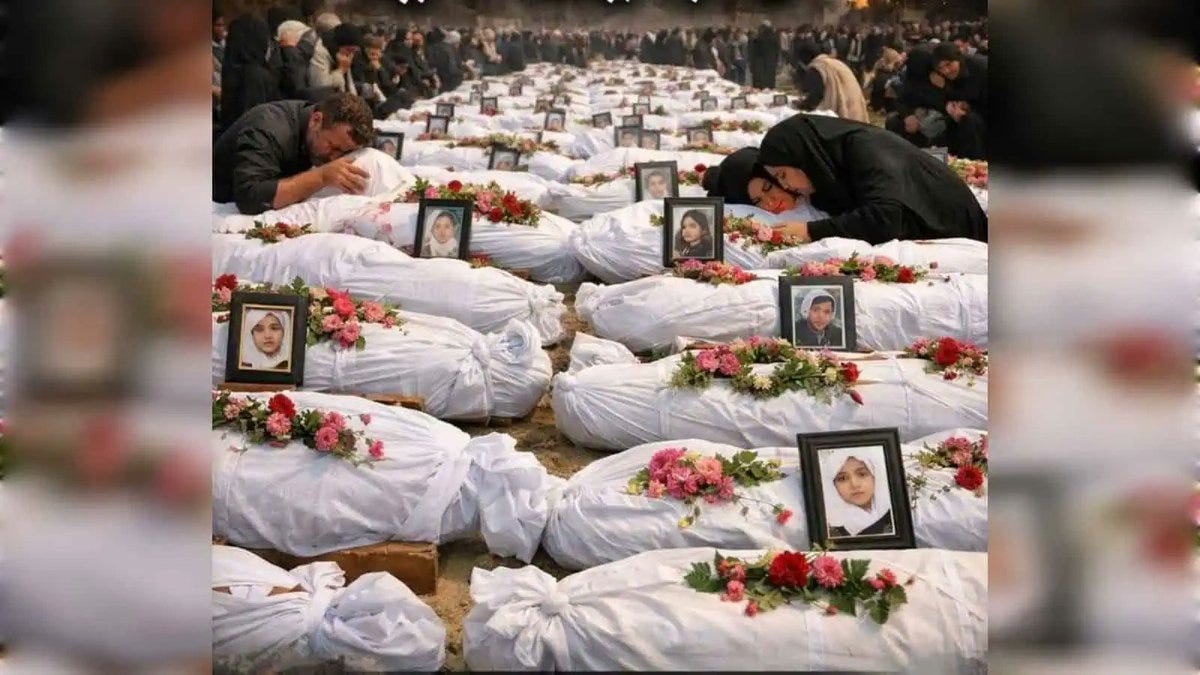
It may seem heartless to speak of this before the dead schoolgirls, the terror of airstrikes in cities where ordinary Iranians live, the metaphorical bombs blowing up international law. But the only long-term remedy to the escalating crisis convulsing the U.S. and much of the world is to render Trump and his dreadful minions as impotent as possible. Apart from ultimately more significant questions about what this aggressive attack by Israel and the U.S. portends for the world order and America’s constitutional democracy, the cure for the Plague of Trump starts with making sure Democrats win both houses of congress in 2026.
How will the attack on Iran affect the midterm elections? Clearly Trump would like a win to tout his bona fides, the way George W. Bush gained traction as the Mission Accomplished leader post-9/11, however illusory that turned out to be.
But I’d wager this war will help Democrats. This won’t happen because large numbers of voters will hold Trump to account for his broken promises to avoid foreign wars. I mean, that should be it, among other reasons. It also won’t be the fact that Trump didn’t bother to persuade the American people that this war was the right thing to do, although that will factor in. (It took Franklin Roosevelt two years to win the public over to the cause of fighting World War II.) But, hey, the Trump “Organization” was a one-man show. That’s how The Donald is used to operating.
There isn’t a lot of support for this war. According to The New York Times, support for has ranged from 27 percent in a Reuters/Ipsos poll to 41 percent in a CNN survey, far below the level of public backing for previous wars. “Given that wars tend to grow less popular over time, the initial negative response portends political challenges for Mr. Trump and his fellow Republicans the longer the fighting continues.”
But the real bottom line is, well, the bottom line. It’s been surprising, and a testament to a modicum of number of Trumpian brain cells that remain, but the U.S. economy has remained fairly resilient as Trump, his Project 2025 zealots, and his Cabinet of Horrors have energetically done the work of dismantling the country.
One of the things I learned covering politics is to look very closely at a candidate’s record. Very closely.
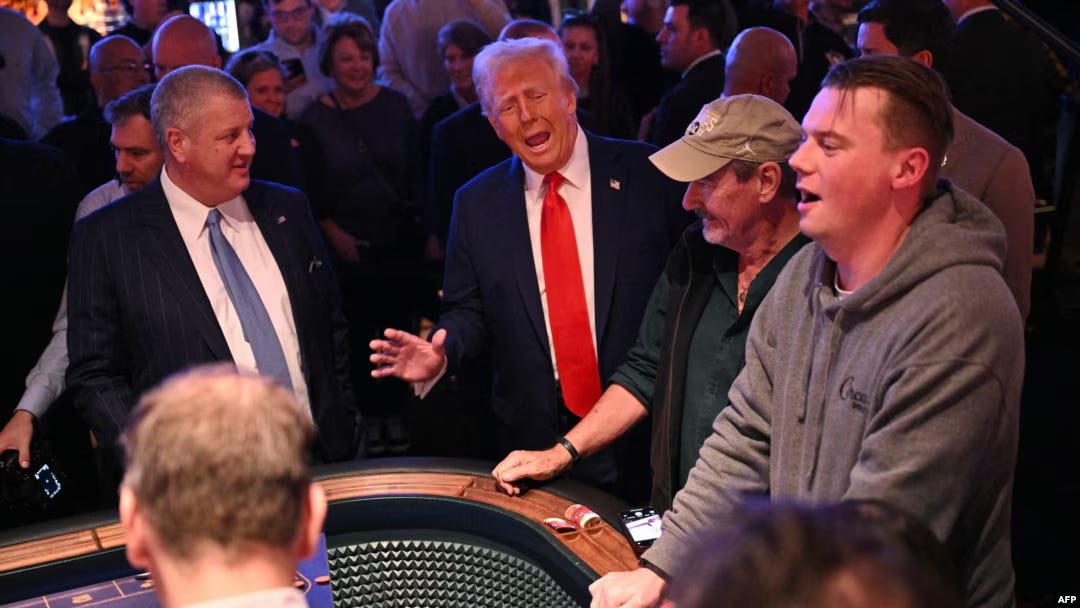
It’s Trump Casino Time again.
The Dow dropped 1000 points this week. What did that do to your 401k, if you have one?
The war is costing $891.4 million a day, according to the bipartisan Center for Strategic and International Studies. There are other estimates of $1 billion a day, reported by The Atlantic.
Here is a note from our friend former Defense Department official Bryan Del Monte of the Long Memo:
This war is costing a billion dollars a day?
What the blue fuck.
I’m not usually shocked by large numbers. Washington deals in large numbers the way carnival barkers deal in stuffed bears. But this one actually made me sit up and say it out loud:
What. The. Blue. Fuck.
For reference: the wars in Iraq and Afghanistan — two actual wars, with troops, supply chains, bases, convoys, and the whole magnificent apparatus of kinetic mayhem — ran about $750 million a day.
That was two wars.
Two.
Now we are told that this little adventure — apparently conducted with fewer boots, fewer bases, and fewer moving parts — will run about $400 billion a year.
One begins to wonder what exactly is being purchased. Are the missiles gold-plated? Are the drones stuffed with caviar?
I guess inflation hits all over. Warflation?
Because at a billion dollars a day, somebody somewhere is running the most impressive procurement scam since the Pentagon discovered the $900 hammer.
Well, it’s Trump, Jake, right? But inflation will be the dealbreaker for the American people. Iran has blocked the Strait of Hormuz, which, in a year, is the shipping conduit for about 20 percent of the world’s oil, 24 percent of liquid natural gas exports, and between 25 and 35 percent of the world’s supply of fertilizer.
After only a week of U.S. bombing, prices at U.S. pumps have jumped an average of 27 cents. The bigger hit was to natural gas. According to the Financial Times, spot prices for Dutch gas on the country’s trading exchange jumped 40 per cent on fears over Qatari exports. Globally, farmers will be hurt, some quite badly, both by fuel prices and impacts on the fertilizer supply chain.
A lot of Americans don’t seem to care about corruption and the rule of law, but they sure pay attention to gas prices. Oil is so interwoven with the U.S. economy, inflation is certain to rise even higher than it’s already jumped because of the idiotic tariffs. Job numbers plummeted last month, down by 92,000 while unemployment rose to 4.4 percent.
Not good for Trump, or any incumbents, for that matter. The only good news, in case you’re thinking of buying a house, is that Trump may get his wish on the Federal Reserve lowering interest rates, if only because the economy is cratering.
The only surprise is that it took this long.
The Venezuelan option. (Not a Wes Anderson movie.)
I have a friend who lives in Israel and over the years, in my estimation, he’s moved pretty far right. I guess running down to bomb shelters every few years can do that to a person, or a country. In any case, while he acknowledges everything that’s wrong with Israel’s ruthlessly corrupt leader, Benjamin Netanyahu, he professes optimism about this war. You know why? This war may indeed be good for Israel, strategically speaking, defanging one of its most effective enemies, a regime pledged to destroy Israel. Or it could do the opposite.
Last weekend, we were frantically trading texts while I was attending parents’ weekend at my kids’ school. He kept trying to convince me that this war is not just an Israeli move, but something that’s good for the U.S. Anthony Scaramucci, the finance guy and Trump apostate who’s reinvented himself as a political commentator, had a very different take:
This is very, very important. Trump is not only wrecking the international order, he’s resetting the table to turn everybody against America, not just our adversaries, but also our allies…He’s doing this because right makes might, and might makes right.
Let’s look at the best case scenario. Martin Wolf, Financial Times Chief Economic Commentator, laid it out in a an opinion piece bluntly titled “The cynical opportunities of ‘Epic Fury’.”
The subtitle cuts to the chase: With this US administration, the best bet is that a business deal is to be reached with Iran.
Wolf describes what is happening now as “precisely the most disruptive scenario I envisaged when the Gaza war began in 2023, namely a war that affects the entire Gulf.”
The Gulf region, he notes, is the world’s most important energy supplier, according to the 2025 Statistical Review of World Energy, containing 48 percent of global proven oil reserves and producing 31 per cent of the world’s oil in 2024. “A prolonged war that disrupts exports from the Gulf or, worse, damages its supply capacity could be hugely costly,” Wolf writes. “The US administration must be aware of this. We may never know why it started the war. But when it insists that it wants a short one, it might indeed be telling the truth. Whether this will be the outcome is another matter.”
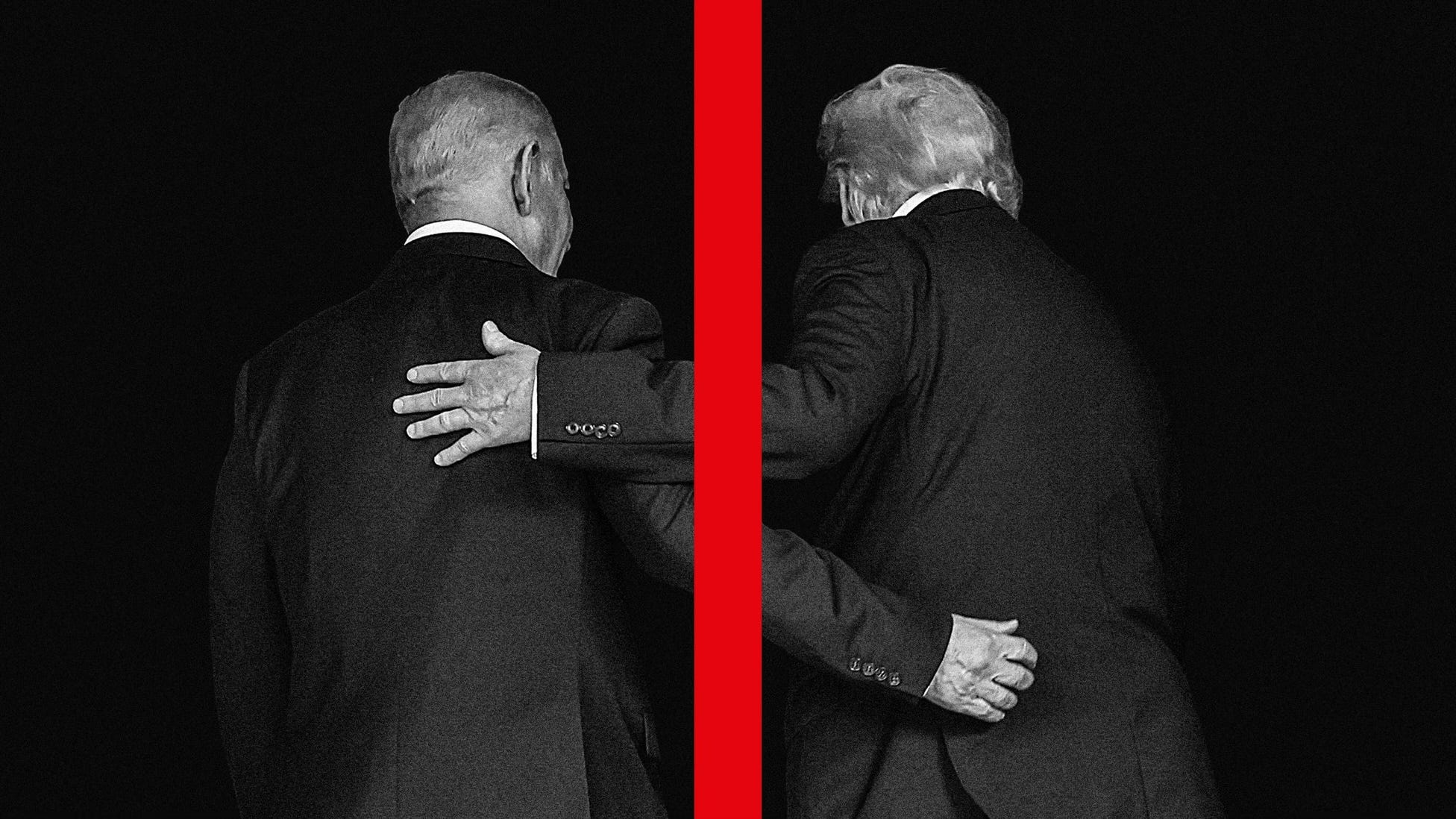
Ever the booster, Trump, Wolf posits, imagines that he can leverage “‘the Venezuelan option’”: go in; reach a deal; get out. It’s not outside the realm of possibility, Wolf writes.
Will there be takers among Iran’s new rulers, after this brutal lesson in US (and Israeli) power? I would bet there will. If such a deal is reached, the Gulf could return to stability, indeed far more stability than in the decades since the Iranian revolution. Moreover, any such outcome could also reduce the most dangerous possibility of any state collapse, of which political scientist Stephen Holmes warns in Project Syndicate — with Iran’s nuclear material, nuclear scientists and engineers let loose upon the world.
A stable Iran that is not at war with its neighbors, even under a dictatorial government, would surely be better than civil war or a failed state, Wolf writes, the other likely alternatives. The goal of a democratic, enlightened Iran is not outside the realm of possibility, long-term, but it seems unlikely with the Iranian Revolution Guard Corps still in control of the country’s arsenal and finances.
Wolf makes it clear that Trump is no friend to democracy, and he doubts whether Trump had any coherent plan before he gave the order to drop bombs. What he does believe in is Trump’s unwavering allegiance to money.
When considering this administration, the best bet is the most cynical. Whether Trump planned it or not, he might have created the conditions for a deal with those who control Iran’s levers of power. Such a deal would be acceptable to its neighbours, who do not want a democratic Iran. US power would have been demonstrated. Europe and China would have been discomforted. Iran’s rulers (and the Trump family) would be richer. What would be not to like about all of this, at least for Trump?
Indeed. Wolf’s case for cynicism is not implausible. Trump already has signaled his displeasure with the mullahs’ most likely candidate for leader, Mojtaba Khamenei, the son of the Supreme Leader Ali Khamenei. Some configuration of the Iranian Revolutionary Guard Corps (IRGC) is the most likely candidate for the new boss that looks like the old boss.
Michael Wolff, the journalist who’s written four books on Trump, recently echoed these sentiments, writing in Howl, his Substack:
“Jared can really work the Arabs. They like Jews to handle the money,” says Trump with great satisfaction, perhaps unaware of his head-smacking antisemitism.
Of all the mixed, unclear, incoherent, and incomprehensible motivations Trump might have in the Middle East, and in the war with Iran, one clear and basic goal always does exist—his own personal advantage. The country should benefit from his actions, yes, but why shouldn’t he benefit too? This isn’t grift; this is fairness. He’s not working for free.
Always, the best way to understand Trump is to focus on what’s in it for him. In any endeavor, however misguided and seemingly inexplicable, there will be an eye-on-the prize calculation of how he personally can come out ahead.
His world, random, disorganized, undisciplined, mercurial, make-it-up-as-you-go-along, has, over decades, always had a consistent focus on his piece of the pie.
The presidency has not changed his way of thinking. As he wages war, oil, real estate, financial partnerships, Persian Gulf capital, and deal-making will be top of mind.
Trump doesn’t know how to fight a war, and he certainly can’t seem to justify one, but with his son-in-law as his bagman, he’ll likely figure out how to profit from one.
The hour of the barbarian is at hand
Will this war achieve anything for the Iranian people? It seems unlikely. Every progressive Iranian thinker seems to be saying the same thing: the Iranian people need to be the ones leading regime change. It goes without saying that if Trump and his droids cared the least bit about Iran, they would have been supporting pro-democracy movements rather than seeing the regime’s weakness as an opportunity to both prove U.S. military might, and, as many charge, distract from the latest Epstein news.
On this note, the brilliant Reza Aslan wrote “The Mistake That Iranians Make About America,” an essay in The New York Times that is too intelligently beautiful to summarize here. You should simply read it yourself. But here is one takeaway:
“If the goal is accountable government in Iran, it makes little sense to place that hope in a foreign leader who has praised authoritarian rule and weakened democratic norms in his own country. The risk is not liberation but the reinforcement of the very model that Iranians are trying to escape,”
Aslan, along with every Iranian intellectual I’ve heard, is saying that the Iranian people need to be the ones leading regime change.
In Foreign Affairs magazine, Iran expert Dalia Dassa Kaye, a Senior Fellow at the UCLA Burkle Center for International Relations, counseled a rapid end to the war and called out U.S. leaders for consistently falling prey to illusion:
At this point, aiming for anything more than damage control is unrealistic, Kaye wrote. “Unfortunately, even as polls show that the majority of Americans oppose the war, too many American leaders continue to harbor fantastical expectations about shaping the Middle East through American power. In reality, that power is diminished by another reckless and costly war. Rather than help usher in a new Middle East, this war is likely to prolong the life of the old one, whether or not change comes to Iran. The time to end it is now.”
Michael Wolff knows Trump well, and his take is that Trump is likely to end the war quickly, although not for the reasons Kaye cites or Aslan hopes for. When it comes to Trump’s M.O., he writes:
Winning was not so much a military or political result, but a function of looking like a winner—that is, stagecraft. The strategic issues of waging war and of achieving a set of specific results were far less important than being able to claim a win; indeed, if you couldn’t claim a win, if you got bogged down in a mess, then you were, well, a loser, and hence had achieved nothing.
So much of Trump’s career, of course, regardless of the evidence to the contrary and the Sturm und Drang that endlessly accompanied him, had been based upon his remarkable and shameless ability to announce his own victories and walk away from whatever mess he had created.
Will Trump walk away? He may find it impossible. Was the war initiated under false premises? Certainly. Iran posed no threat to the U.S., full stop. Longtime investigative reporter Seymour Hersh’s reporting indicated that there had been a plan to incite the Iranian military to rebel against the regime - not a perfect solution, but still the most likely end game in the current situation - but neither Netanyahu nor Trump had the patience to let that scenario play out. Instead, we are seeing a replay of the terror and mass death that Israel has visited on Gaza.
Lydia Polgreen of The New York Times has been there and done that as a foreign correspondent. She makes a larger point that is worth considering as a frame for assessing the effects of our mad king’s unilateral action.
For America, the repercussions are just beginning. At least six American service members have been killed, and the Pentagon, pointedly not ruling out boots on the ground, has said more casualties are likely. Despite relentless attacks on Iran’s military installations, the country has responded with relentless force.
It has rained missiles and drones not only on American and Israeli targets but also on the Gulf countries — the United Arab Emirates, Qatar and Saudi Arabia chief among them — that play host to American military bases. Airports, hotels, data centers and energy infrastructure have been struck, causing chaos. Meanwhile, the Strait of Hormuz, a crucial choke point for the export of oil and gas, is all but closed, sending shudders through energy markets.
This is the world Trump tries to disavow — complex and interconnected, resiliently interwoven and yet vulnerable to disruption. The Gulf embodies it like no other place. An apotheosis of globalization, it is a crossroads of money, people and power deeply intertwined with not just America’s fortunes but also Trump’s personal wealth. More than anything, it shows up — in its grounded flights, shuttered refineries and intercepted missiles — the fallacy of Fortress America.
Polgreen ended on an even more profound note:
Watching Hegseth rant about limitless killing, I remembered the words of the anticolonial poet and leader Aimé Césaire. “The hour of the barbarian is at hand,” he wrote in his “Discourse on Colonialism” in 1950. “The modern barbarian. The American hour. Violence, excess, waste, mercantilism, bluff, conformism, stupidity, vulgarity, disorder.”
If war is God’s way of teaching Americans geography, perhaps it will also serve as a lesson to Trump. It should be a simple one: Other places and other people are real, possessing their own agendas and agency — and America’s actions have consequences it cannot control. Anything else is pure fantasy.